Seeing as I am a 24-year-old that is a solid 6 out of 10 with the maturity of a 4th grader and the financial wherewithal you would assume a movie blogger would have, it should come as no surprise that I have never been married (Hit me up, ladies!). I have been blessed to witness my parents’ in a loving marriage for my entire life, but that is the extent of my knowledge of civil unions. So, while it may be foreign to me, marriage is one of the world’s most common institutions, and the story of the decay of a family through a divorce is a story that so many people can empathize with.
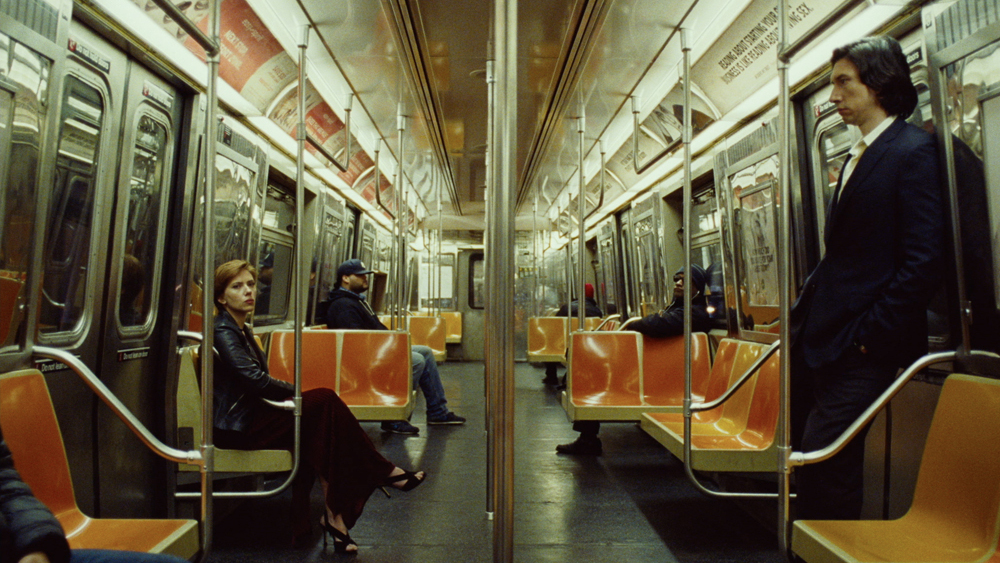
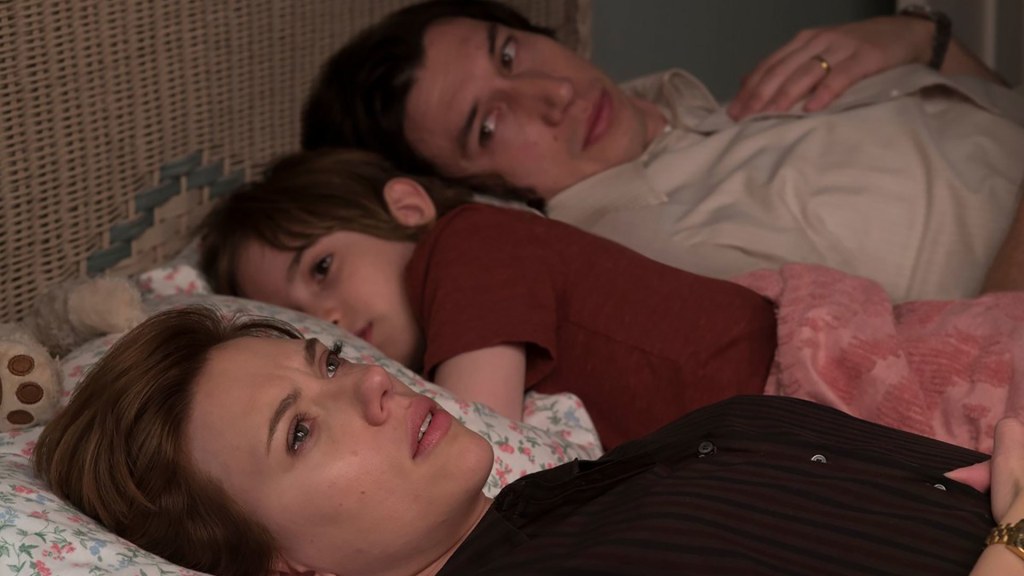
Noah Baumbach creates an amazing experience with this film. He begins by giving both Nicole (Scarlett Johansson) and Charlie (Adam Driver) about 3 minutes each to describe the reasons and qualities that made them fall in love with each other over a montage of them pantomiming happiness. But after these opening moments, we are bombarded with heartbreak until the very closing moments of the film. We are quickly built up to appreciate why they love each other and are given about 2 hours to watch something we understand was genuine crumble before our eyes. It is a relatable tragedy that consigns its characters’ pathos exceptionally onto its audience.
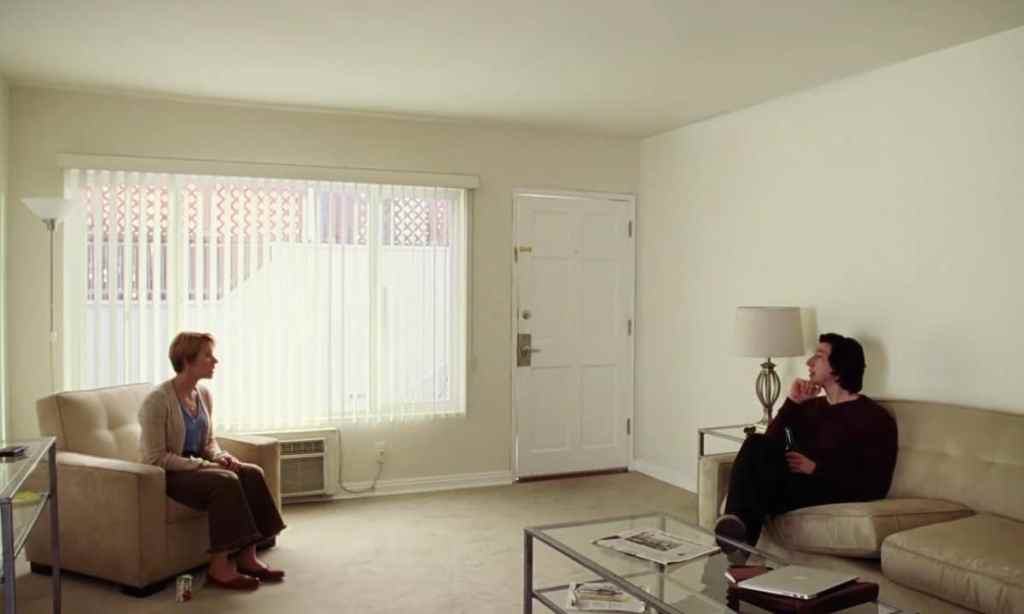
It should not take the keenest eye to notice that the film is driven almost entirely by dialogue. Every competent script requires dialogue to function, but when all events on screen are conversations rather than actions, there is risk associated with that decision. The pacing could potentially become an issue as things happen much less frequently and you may see two characters in a room simply talking about the same subject for extended periods. “Marriage Story” turns this potential pitfall into one of its strengths, as it will captivate while juxtaposing itself with the knowledge that it is fighting an uphill battle.
The writing is noteworthy, but I can’t help but wonder if the film would thrive the same way if not for Scarlett Johansson and Adam Driver delivering career-defining performances. The casting for the leads is reasonably the biggest draw to the film, and they each perform theatrically yet never straying into over-the-top melodrama. Scarlett’s Nicole is a woman trying to capture the agency she felt she surrendered in her marriage and Adam’s Charlie is a man who needs to grow in maturity and learn to see situations beyond his own perspective. He has sympathy but not empathy. You know that they truly do care for each other while simultaneously not being good for each other. Both characters undergo palpable character arcs that communicate vividly just how life-changing an experience that divorce is, punctuated by an argument that serves as a climactic catharsis of their respective experiences.
I did enjoy the supporting cast as well, although their impact pales in comparison to that of the leads. Alan Alda stands out as the sympathetic divorce lawyer who is seemingly Charlie’s only ally in the entire film. He provides heart and feels like a much-needed shoulder to cry on for the few scenes he is on-screen. Similarly, Laura Dern is Nicole’s lawyer, and while she is openly supportive of her, you can’t help but feel that she could easily flip the switch to being cut-throat at any minute. It is difficult to determine if she is antagonizing Charlie or simply helping Nicole.
I am sure this film will hit differently for everyone who sees it. I have made my relationship with the material know, but all of our experiences are unique. Perhaps you can relate to your own experiences. Maybe you have seen someone you care for dealing with divorce. One thing I can promise is that we all have someone in our life we care about, and “Marriage Story” forces us to confront the idea that things will not always be perfect with that person and the reality of learning to adapt to how life would change as a result.
While the quality is undeniable, I doubt anybody will genuinely enjoy their time watching the movie. An honest assessment of this movie is that “Marriage Story” is not truly a piece of entertainment. It feels more like being forced to eat vegetables as a kid. It is not easy to be faced with powerful emotions, especially ones of heartache. It is hard work but, in the end, it is good for you. I recommend you give this film a watch at least one time because it’s as simple as streaming it on Netflix and you are most assuredly going to see the names associated with it during award season.
I give “Marriage Story” a 9.0 out of 10
Starring: Scarlett Johansson, Adam Driver, Laura Dern, Ray Liotta, Alan Alda Directed by: Noah Baumbach Rated: R Runtime: 2 Hours and 16 minutes
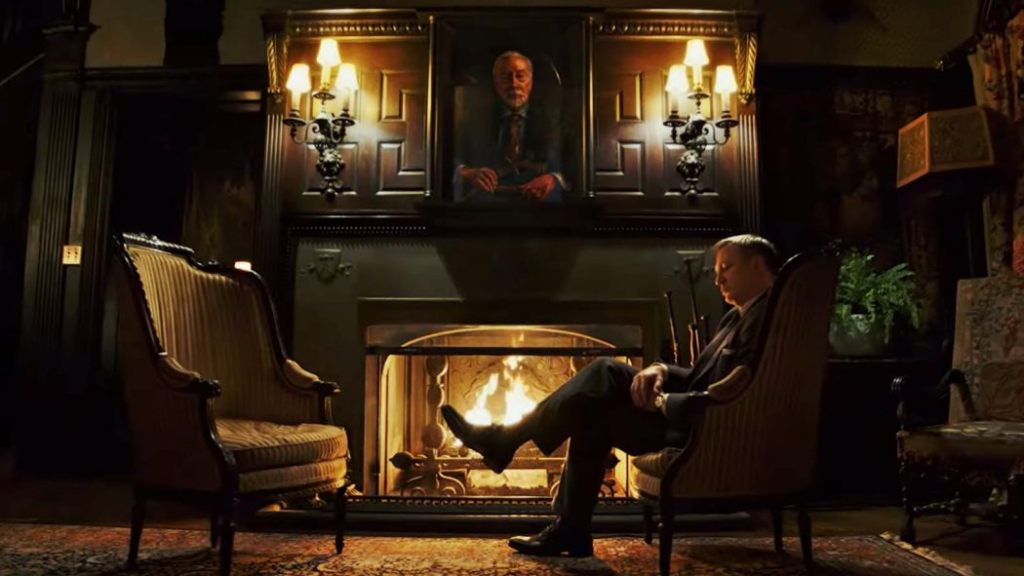
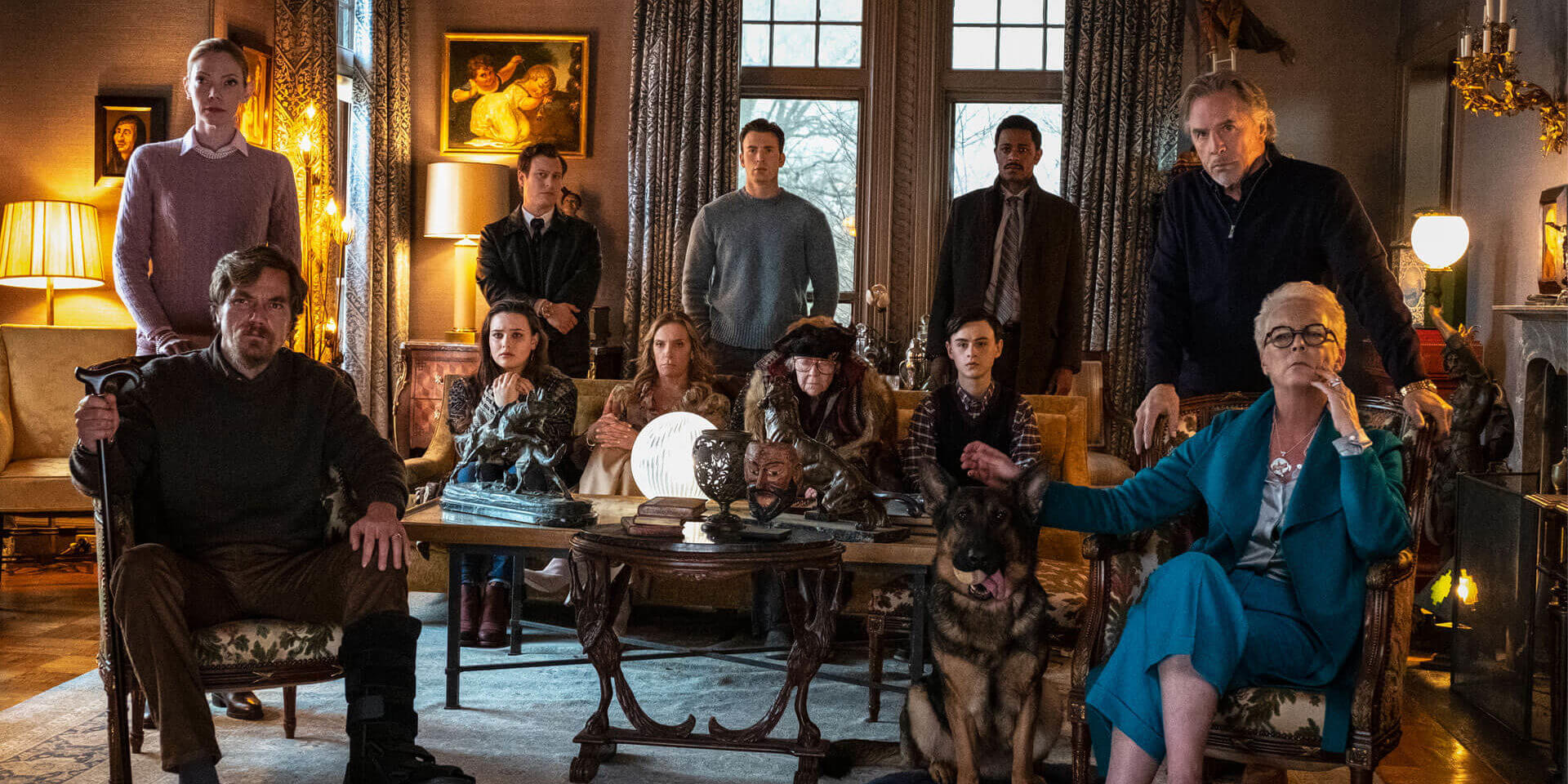
“Knives Out” is the latest film from director Rian Johnson, the suspect director of the notoriously divisive “Star Wars: The Last Jedi”. Considering he is a man of outstanding character, it is strickingly odd that his presence is considered as controversial as it is, but thus is the nature of ‘Star Wars’ fandom. Whether you love him, hate him, blame him, champion him, or anything in between, his newest film is a blank slate and a new chance to create a compelling story for audiences to enjoy. With this film, he’s assembled a deep ensemble cast of talent for a classic “Who done it?” murder mystery!
As is the nature of the mystery genre, you are supposed to go into the theater not knowing things. So, this review might seem a bit bare in comparison to others to avoid spoiling anything. The story has been touted as a unique and clever twist on the classic mystery formula, but does it deliver on that promise? Well, it is definitely a fun film, but I am not sure it is as smart as it thinks it is. That is not to say that it is bad or poorly written in anyway, just not a groundbreaking concept. But that is ok! Not everything needs to be a prophetic revisioning of reality for it to be an entertaining movie.
As I mentioned, “Knives Out” is comprised of an incredibly deep cast of actors who all have moments to let their natural charm shine through. And yet, despite what the marketing department might have you believe, there is a defined lead in this film and it is not Daniel Craig or Chris Evans. No, it is Ana de Armas’s Marta, who amazingly is hardly present in any of the film’s pre-release materials. But do not let her noticeable absence from trailers and posters alarm you. She delivers one of the finest, most enjoyable performances from a lead actress I have seen all year. In fact, her presence in this film solidifies her as a talent to keep an eye on in the future.
The supporting players all are enjoyable, but rather one-note. For the most part, they are each given a scene or two to flex their acting muscles by employing a quirk or oddity. At first, they all seem fun but you soon realize that is the extent of the individuality of most of the characters. Occasionally, maybe someone breaks the mold, but they are all mostly the same underneath that first layer. Daniel Craig gets the most freedom in the film and it is a joy to watch him solve things in an over-the-top southern accent. He is charming and provides most of the film’s humor.
As far as the story goes, I probably should avoid saying too much. However, I will say that Rian Johnson’s strength in writing is when he focuses on the main story. “The Last Jedi” was at its strongest when it focused on Rey and Kylo Ren, and it lacked focus when it strayed into subplots and political messaging. The same seems to be the case with “Knives Out” as the parts that are centered around Ana de Armas, Daniel Craig and the murder are very entertaining and engaging. Unfortunately, he ventures once again into subplots that do not go anywhere and political ideas that are discussed in some of the most surface-level cliché dialogue that almost seemingly is executed under a talking-point checklist. Similar to the addition of the war-profiteering and animal cruelty messages from “The Last Jedi”, Rian adds politics into this film with the nuance and tact of a Twitter comment section. Even if you agree with the message he is trying to push, you can’t help but feel agitated by the simplistic understanding of his arguments. A good message argued poorly does no one any favors.
Considering the poor taste I had in my mouth from his last project, I enjoyed “Knives Out” more than I was prepared to. It is the type of film you should watch with a group of friends in a real casual setting. The mystery is challenging enough to attract your attention but not too challenging that you couldn’t still converse throughout it. You will have a good time watching it, but “Clue” is still the reigning heavyweight champion of the murder-mystery genre.
I give “Knives Out” a decent 8.0 out of 10
Starring: Ana de Armas, Daniel Craig, Jaime Lee Curtis, Chris Evans, Michael Shannon, Christopher Plummer, Don Johnson, Toni Collette, LaKeith Stanfield Directed by: Rian Johnson Rated: PG-13 Runtime: 2 Hours and 10 Minutes
They had it! It was right there! And some poorly thought-out last-minute decision that goes completely against everything that was set up before it swoops in and snatches defeat straight out of the jaws of victory! I was not prepared to say this here, but these are trying times and not everything goes as expected. As tragic and hyperbolic as it sounds, I will declare “Ford v Ferrari” to be the victim of the single most profound unforced error that I have witnessed in a film this year.
I will be honest, going into my viewing, I had only mild expectations for the film. I honestly hated the title because it sounded like an elementary school show that 1st-grade students put on for their parents to show that they mastered Venn diagrams. Also, the idea that I am somehow supposed to sympathize with Ford as the likable underdog instead of the anti-Semitic corporate juggernaut was beyond me, but my dad, who I saw the movie with, is a big ‘car guy’ so it seemed like a great opportunity for that classic father-son bonding time society eats up. Plus, I love Christian Bale, Matt Damon, and director James Mangold, so I’d give it a shot! And I ended up loving it!
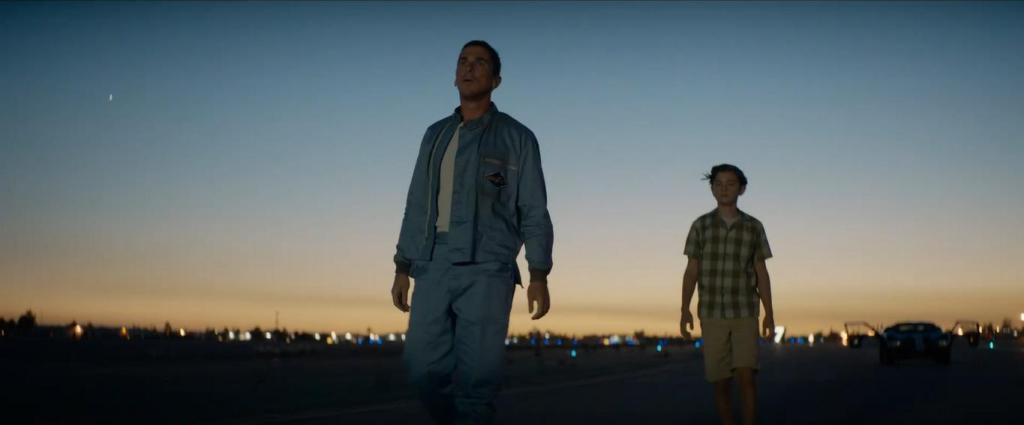
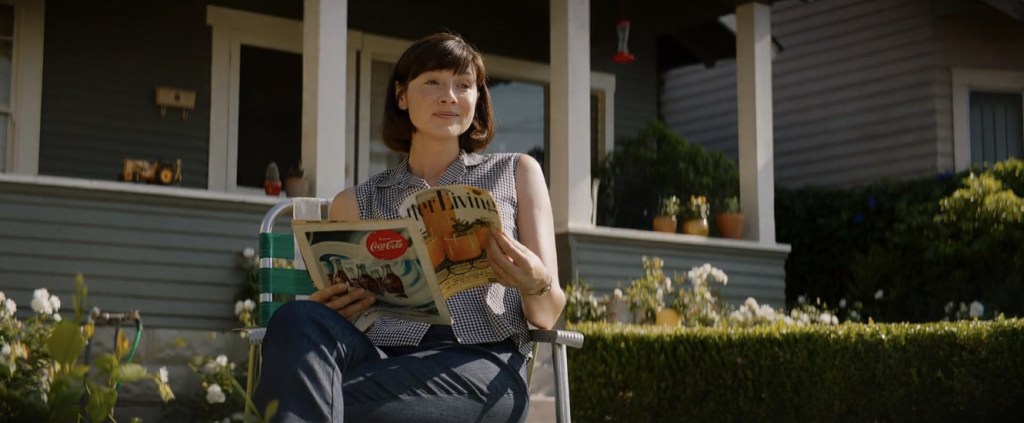
I was so pleasantly surprised by “Ford v Ferrari” that I was just about to give it a 9.0 out of 10 (which would have qualified it to get a Best Picture Nomination on my ballot)! Bale and Damon were tremendous! They radiated charisma and understanding of their characters. Every moment with both of them was a treat. But I had always assumed that much would be the case. What caught me most off guard was just how self-aware the film was. Mangold never tries to make Ford the good guys. Other than our leads and John Bernthal’s Lee Iaccoca, everyone associated with Ford is portrayed as a snobby corporate-type that doesn’t deserve to win, specifically Josh Lucas’s Leo Beebe. I even realized that the title was purposefully misleading and clever. The story is really about Damon’s Carroll Shelby and Bale’s Ken Miles v the corporate executives at Ford, and the movie won me over! Until…
…Until that ending came in like a clean sweep to the nads. I will qualify this by saying that I understand that “true stories” need to follow facts to an extent. Typically, films will stay loyal to the big events and be flexible with the smaller details, so I have no objection to how the race ended. That was really how it happened, so if that bothers me, I should take it up with history, not the filmmakers. Hell, the film actually creates a fairly satisfying ending despite a frustrating result. At this point, the story is complete. Our characters have grown from their experiences and their tasks have been completed over 2+ hours of screen time. It was over! Roll the credits!
I apologize if this comes off as a spoiler but I HAVE to discuss this. After Josh Lucas’s character spends the entire film actively hating Bale’s character, he pulls a dirty trick in the final race at the detriment to Bale. That part is seemingly a true event. But then the film has the audacity to kill Bale in the next scene! Why?! The story is over! You are already asking the audience to be the bigger person by taking a moral victory instead of an actual victory, which is difficult enough but HOW DARE YOU tack on his tragic death to a story that did not need it?! I left the theater IRATE!
Killing Bale serves zero purpose to the story. He may have actually died that way, but in the context of this story, it provides no sense of closure or growth. All we get is just two meaningless scenes of Matt Damon crying, possibly to make his case for an Oscar more compelling (?), which wasn’t even necessary. You couldn’t even throw in a quick scene where Josh Lucas’s character gets what he has coming to him? Nope! He just gets away with it and our likable protagonist dies in a fiery explosion right in front of his son, immediately after getting what he earned stolen right out from under him.
I hold Mangold, who wrote and directed the film, responsible for this. He is a terrific filmmaker and he made a terrific film, but that ending was the equivalent to a football player having a breakaway to the endzone then dropping the ball before he crosses the line. It simply did not need to be this way. Simply cut the last 15 minutes from the film and you have yourself a real winner. But those closing moments are so poisonous to the film as a whole that it ultimately ruins the experience, and this bitter taste in my mouth will forever be the feeling I associate with the film.
I ultimately will give “Ford v Ferrari” an 8.0 out of 10. Most of the film is great and that much shouldn’t be overlooked.
Starring: Matt Damon, Christian Bale, John Bernthal, Josh Lucas, Caitriona Balfe Directed by: James Mangold Rated: PG-13 Runtime: 2 Hours and 23 Minutes
Unfortunately, I do not live in a city important enough to have “The Irishman” playing in an actual theater, so much to the dismay of director Martin Scorsese, I was forced to stream the film on Netflix… at home (Insert ominous music and thunderclaps here)! Inarguably, my actions are an affront to the almighty, but alas, sacrifices had to be made, and thusly, I trekked on to see Scorsese’s new creation in suboptimal conditions. And, since I was not able to see “The Irishman” in theaters, the film was viewed by many before I was able to do so myself when it was available to be streamed last week. Oh, forgive me for my insidious indiscretions!
One would be forgiven if they believed “The Irishman” was going to be the second coming of “Goodfellas” since all promotional materials pointed towards a high-octane ultra-violent thriller in the same vein. While the similarities on the surface are undeniable, “The Irishman” is a far more introspective take on the genre. The film explores politics, personal relationships, conscience, purpose, and consequences. This is not 3 hours of adrenaline and hedonism but a contemplative take on violence and the impact of one’s actions.
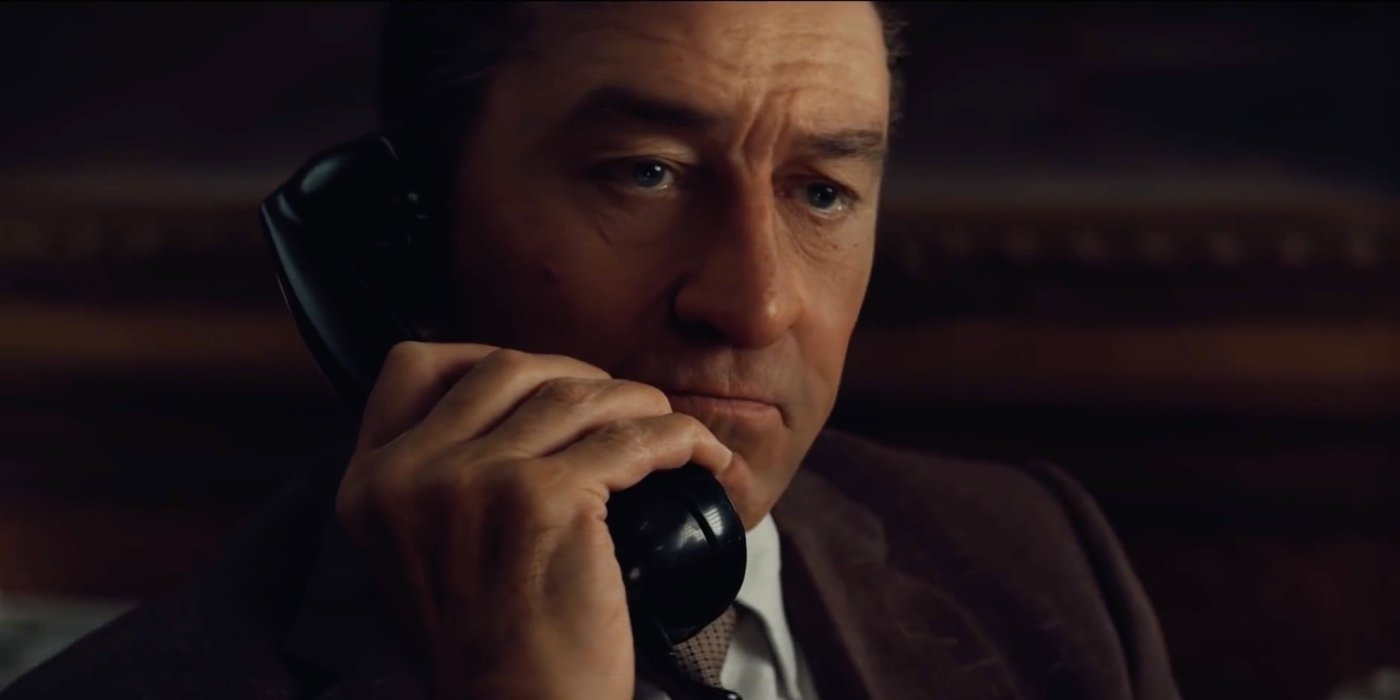
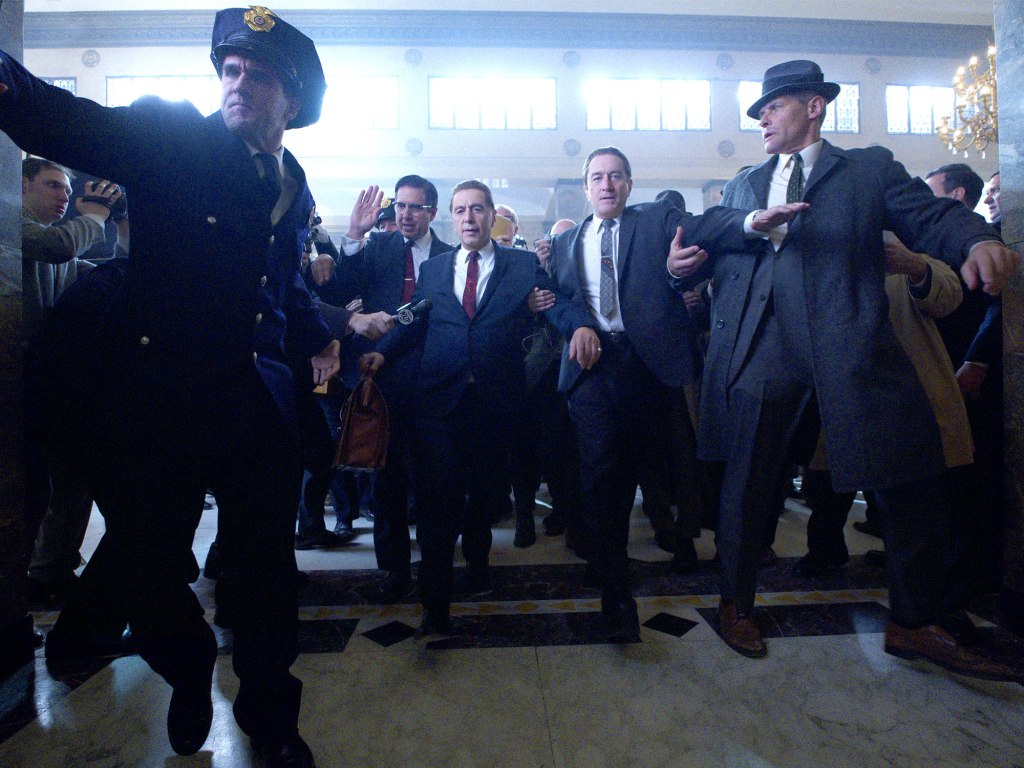
Martin Scorsese is one of cinema’s most talented filmmakers, and while he has proven beyond a shadow of a doubt that he can make fantastic films of all genres, he returns to his roots with “The Irishman”. The story is a crime drama about notorious Philadelphia mafia hitman Frank Sheeran (Robert De Niro) as he works his way up the ranks and eventually into the service of legendary Union leader Jimmy Hoffa (Al Pacino), as well as the unsolved mystery of Hoffa’s murder. As Sheeran forms strong relationships with Hoffa and crime boss Russell ‘Russ’ Bufalino (Joe Pesci), he continues to push his family farther away.
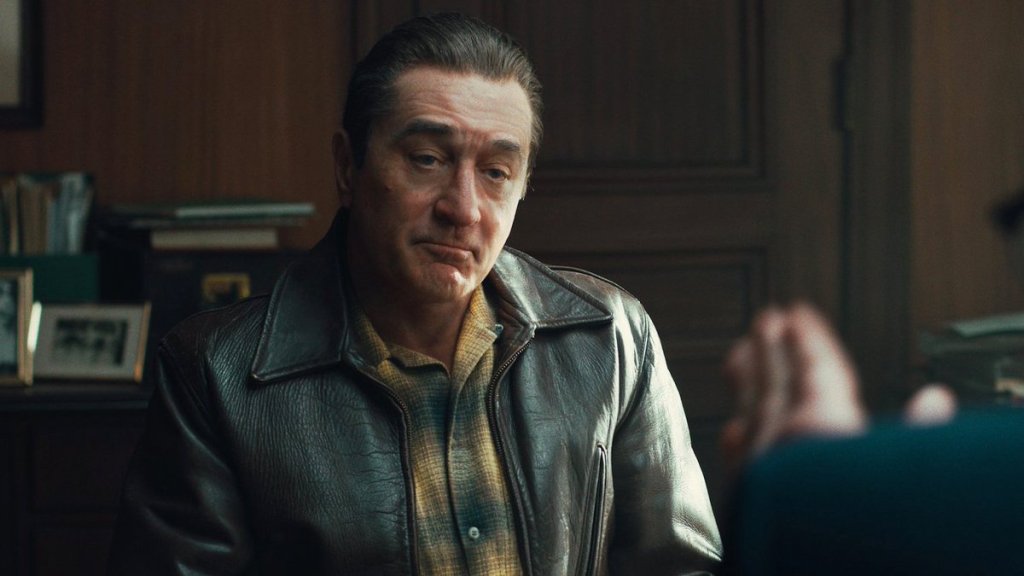
De Niro’s Frank is the movie’s main character, yet the way the film is structured, the three main actors each effectively dictate sections of the narrative. While the story is always about Frank, told from his perspective, Russ is in control of the first third, Jimmy the second, and Frank the final third. Frank, as an underling/bodyguard, is always controlled at the behest of the more powerful figure he is with, and it isn’t until the main plot is over that we really see him become his own man instead of the soldier everyone expected him to be.
The final act, which is more of an epilogue to the story of Frank, Russ, and Jimmy, is arguably the strongest. You could make the case that the film could have cut the last half hour or so and it would still have been a complete narrative, but these moments provide genuine insight and heart. I will not discuss the specifics to avoid spoiling the ending, but we are given a glimpse of what happens after the fact that is rarely ever explored in films. At this point, the plot is concluded and the characters are just left to deal with the fallout of what they have done. It is the ending that completes the vision of Scorsese and differentiates the film from many of its predecessors.
Much has been made about the use of technology to de-age the actors since the main cast plays these characters over the duration of multiple decades. I can safely say that with the exception of one brawl scene in the first act, the illusion used to make these actors seem younger is practically flawless. The technique is mostly used on De Niro and sparingly on others. The single exception I mentioned is startling in contrast, but it is not because the technology failed, rather the natural difficulty associated with making a 76 year-old-man physically move like a man in his 40s.
The trio of De Niro, Pesci, and Pacino deliver tremendous performances. Pacino as Jimmy Hoffa is vintage with his deep, raspy inflection painted all over flamboyant and charismatic speeches. Scorsese said he thinks it is a shame that people today no longer remember who Jimmy Hoffa was, and Pacino’s performance certainly does the man justice. De Niro is much more somber and understated. He is burdened with a larger responsibility than the rest of his co-stars. While the intensity he is known to bring to his roles (as well as that face he always makes. You know the one I mean) is present, he displays a balance of heartlessness and sympathy which culminates in a thoughtful and complex character.
But even with the praise rewarded to both of them, Joe Pesci’s performance is my personal favorite. Although he is effectively retired from acting, there is no evidence of any rust by delivering a performance that goes against the grain. Russ is not the typical loud, over-the-top role that won him the Oscar in “Goodfellas”, but a restrained, calculated leader with influence. You fear him, but not because he is unpredictable, rather unshakable. You respect the dynamic power he possesses while simultaneously fearing it. What I find even more moving are the very subtle ways he expresses affection and humanity, which occasionally shines through the cold façade he puts up.
The supporting cast also pulls their weight. Specifically, I find it to be a treat to see Ray Romano play Joe Pesci’s cousin in a production of this quality. If you grew up on the actor’s sitcom like I have, it is just so easy to root for him. Anna Paquin plays an adult version of Frank’s daughter Peggy, and while she isn’t heavy on dialogue, her very presence communicates more meaning than you can find in entire films. And throughout the story, we are also introduced to gallery of colorful mafia figures that the film immediately discloses how and when they met their demise. It is a running gag that seems like a dose of dark humor but in reality, helps punctuate the eventual realization we are supposed to make.
Despite the obvious quality, it is unclear to me if “The Irishman” will have the same legs as some of Scorsese’s other works. The runtime is a big factor that certainly handicaps the film’s re-watchability, as well as the more serious and thought provoking aspects. But I am completely comfortable admitting that I could be misreading audiences. It is unfair to compare it to films that have had decades to build up a legacy and following, so only time will tell if this will achieve the same impact. But, if the conversation surrounding a film upon its public release is whether or not it can maintain its praise for decades like “Taxi Driver”, “Raging Bull”, “Casino”, or “Goodfellas”, I’d say that film is pretty, pretty good. “The Irishman” did not end up being the film I expected it to be, but I think it might be better in the long-run because of that.
I give “The Irishman” a 9.4 out of 10
Starring: Robert De Niro, Joe Pesci, Al Pacino, Ray Romano, Anna Paquin, Harvey Keitel Directed by: Martin Scorsese Rated: R Runtime: 3 Hours and 28 Minutes (Damn!)
From the beginning of my time reviewing films, I have
made my opinions on the biopic genre very well known. While the likes of “Bohemian
Rhapsody” and “Rocketman”, amongst others, garnering praise from many critics,
they struck me as cliché and unfocused. I would go as far as to describe those
films as well acted, loosely connected series of events devoid of an actual
plot or story. With few exceptions, the genre has become a simple vehicle for
actors to do an impression of a famous person and try to win an Oscar. The
trend these films represented was so disheartening that I almost gave up on the
genre as a whole after viewing “Judy”. However, Harriet Tubman is too important
of a hero of human history to have her story be prejudged by the failures of
others.
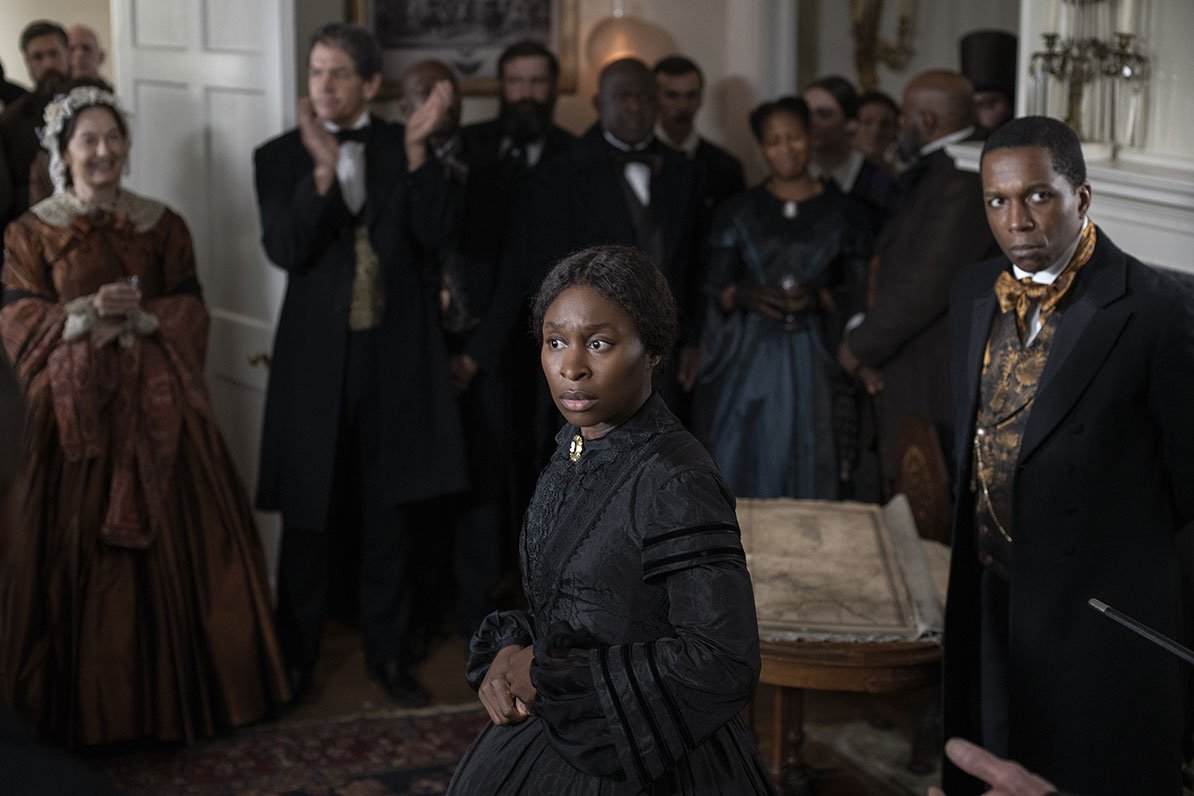
It is my pleasure to reveal that “Harriet” does, in
fact, have an actual narrative. The film follows Harriet (referred to as ‘Minty’
while in bondage) as she first escapes slavery by her lonesome to the Free
State of Pennsylvania, and then her heroic missions to free slaves with the
help of the legendary Underground Railroad. There are a real focus and sense of
organization of events, where everything ultimately plays out with purpose, and
it is because of this that I believe “Harriet” is the most complete and competently-made
biopic of the year.
In the lead role, Cynthia Erivo delivers a mostly
subdued performance full of quiet authority. Although there are a few moments
where she is asked to drift into the cliché for the sake of telling the people
around her not to “tell her what she can’t do”, the majority of her screen time
is not plagued by that poor direction. But the difficulty of the task presented
to her is one of considerable pressure due to the importance of her character. Harriet
Tubman is idolized for her heroic and selfless actions of courage to give
freedom to those who have been subjected to humanity’s most wicked deeds. This
is not an easy role to fill. Audiences want her to succeed because Harriet
deserves Erivo’s best and I believe she reached her goal.
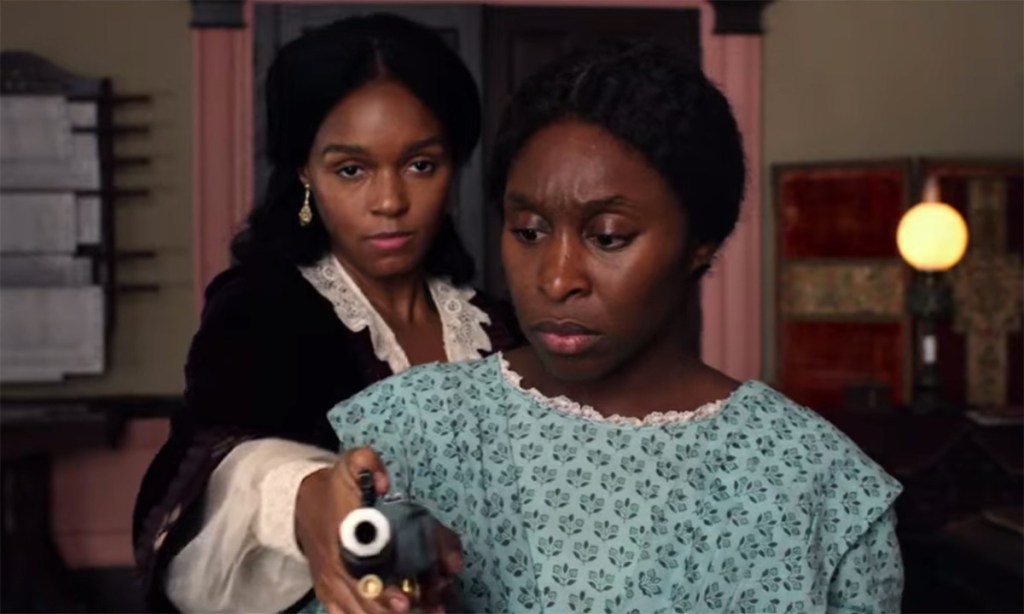
The supporting cast does a fairly decent job as well. While no one delivers a truly show-stopping performance, Leslie Odom Jr. Janelle Monáe, and Vondie Curtis-Hall all play their roles with charisma and poise. I wish they received some more screen time, especially Curtis-Hall’s Reverend Green. I would have liked to have seen how his black reverend in the south who preaches to slaves that the gospel teaches them to love their masters, yet helps them escape under the cloak of night, deals with the consequences of Harriet’s actions, specifically the changing dynamics with the slaves and slavers that result from it. I believe this would have elevated him beyond just a forgotten side-character, and while I suppose the same could be said about most other side characters, I personally would find this avenue most interesting.
An element the film chooses to focus heavily on Harriet’s ‘spells’, which are hallucinogenic visions she had been storied to frequently have. When she was young, she suffered head trauma that the film says began to trigger these episodes which appear to be seizures. Harriet describes them as messages from God, showing her glimpses of the future. Harriet’s faith is a major force in her life, so it is fitting that the film addresses its importance to her, however it is used as such a convenient plot device that just solves most of the obstacles in front of her. It is unclear how often or when these ‘spells’ really happened, so it just comes off as repetitive when the narrative is constantly moved along by a deus ex machina.
What is most unfortunate is that despite being soundly-made, well-acted, and based on exceptional source material, “Harriet” still feels lacking in impact. This is history’s strongest black female hero who quite literally receives prophetic visions, and yet, it feels mostly underwhelming. Perhaps it is because there is no real message to the story other than the usual “Strength comes from within” or “Slavery is bad”, or maybe it is the completely forgettable (and apparently not even real) villain of Gideon Brodess (Joe Alwyn). You will leave the theater thinking the film is decent, but in a few days, you will move on. I believe “Harriet” is just another casualty of the biopic genre. It is certainly a step in the right direction for storytelling purposes, but the reliance on the expected continues to dull historical stories that deserve better.
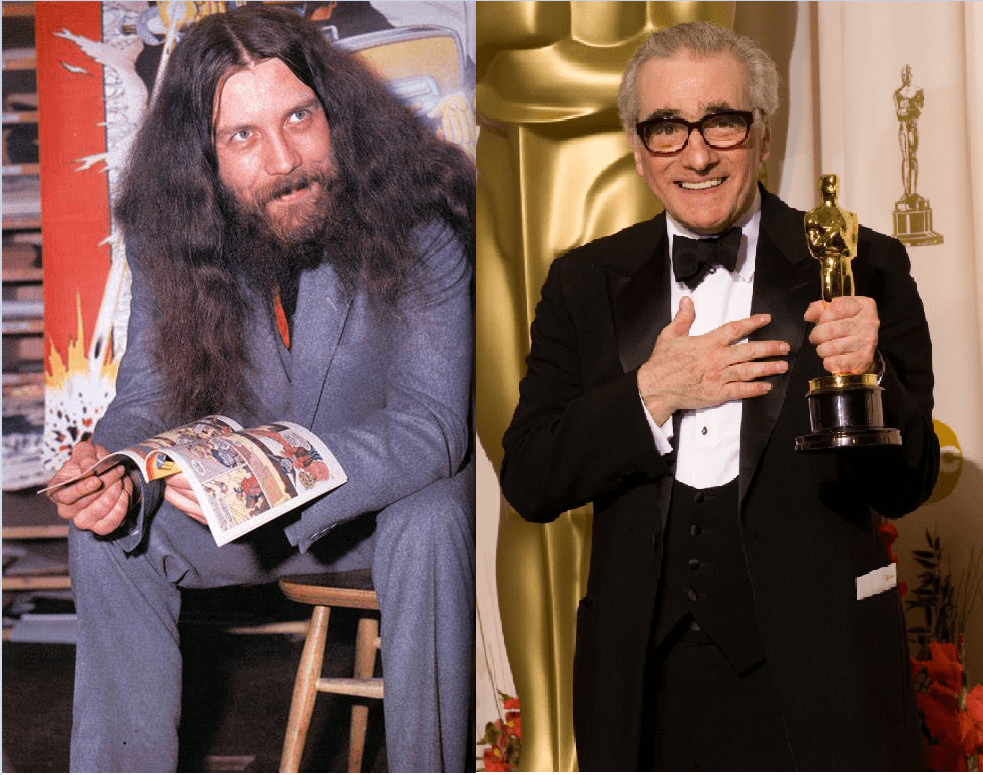
A few weeks ago, legendary filmmaker, Martin Scorsese was in the news for being critical of Marvel films. The headlines read “Scorsese says ‘Marvel isn’t cinema'”, which prompted many on the internet, myself included, to read the comments, then respectfully disagreed. The topic was fodder for quoted tweet comebacks calling him an out of touch old man to go viral all over social media, but I tried not to give it too much attention. While I never had direct knowledge of his stance on the genre, I had always assumed they wouldn’t appeal to a person with his experience making movies. To me, it was a non-story. I had fully planned on letting the topic die out without much resistance from me. That is until a 3-year-old interview with Alan Moore with Brazilian newspaper Folha de São Paulo began to surface.
In the interview, Moore revealed many specific criticisms of his of comic book culture. Alan Moore, for those of you who are not familiar with his work, is the author and creator of some of the most revered comic books ever published, including Watchmen, V for Vendetta, The League of Extraordinary Gentlemen, and my personal favorite comic book, Batman: The Killing Joke. There are few sources in the world who are a more relevant authority of comic books. The full quote is linked in the tweet below.
After reading his comments, I was compelled to revisit Scorsese’s New York Times Op-Ed on the matter. What was once something I had just considered background noise now emerges as a legitimate conversation worth having. Now we have one of the highest authorities on filmmaking and one of the highest authorities on comic books both coming out, separately, offering powerful criticisms. To be clear, I still disagree with both of them on the conclusions they have reached. I do not believe superhero culture is an embarrassment nor that it is not cinema. HOWEVER, each one presents valid points that house considerable merit.
What I appreciate most about these criticism is just how well thought-out they clearly are. As I said, both of these men are the heights of their respective profession, and in regards to their particular angles, they have provided considerably thought out reasonings for their positions.
Let us begin with Scorsese’s remarks. He believes his remarks were taken out of context and overblown to get ‘clicks’ online, which if we are being honest, is 100% what happened. Having said that, the reporting of his remarks do generally describe his conclusions accurately. He calls Marvel “theme park attractions” because they are more corporate projects designed to mass produce films that bring in revenue. The copy-and-paste nature of many of Marvel’s films is an undeniable quality of the franchise that has been the subject of plenty of scrutiny in the past. In fact, I find myself fully agreeing with him when he says “They are sequels in name but they are remakes in spirit, and everything in them is officially sanctioned because it can’t really be any other way. That’s the nature of modern film franchises: market-researched, audience-tested, vetted, modified, revetted and remodified until they’re ready for consumption.”
Moore, on the other hand, seems more hostile. In the past, he has been outspoken about how he is displeased with how his works have been adapted to the big screen to the point where he has refused all royalties and credit for their production. I happen to be a big fan of the film “V for Vendetta”, but it is his right to be critical of how someone else represents his vision. Being critical may not be a new phenomenon, however his points dig deep. In particular, the comment that these films still propagate the fantasy of a dominant white race and the cultural stagnation resulting from their portrayal immediately left an impression with me. Although I sincerely doubt that the intentions of these modern filmmakers are that malicious, I cannot help but feel that there is still a noticeable amount of truth to what he says.
Think about the typical “poster boy” for each of the major franchises: Captain America and Superman. Both are usually portrayed as the perfect beings fighting some lesser being by using a self-righteous set of values. These characters are designed as propaganda for a superior race would be designed. And the more they are portrayed as “perfect”, the more that image of perfection is propagated. Again, I do not agree with the conclusion he reaches, but I do understand his reasoning.
More importantly, he is correct with regards to diversity in the genre. At the time of the interview, 2017, the only true big screen superhero portrayal was Wesley Snipes’ “Blade” trilogy. Studios’ failure to stray from the lowest common denominator in favor of a more realistic representation of the variety of backgrounds these characters was a highly debated and criticized element of the genre. Thankfully, since these comments were made, there has been strides of progress in the name of representation. “Black Panther” became a cultural phenomenon, Anthony Mackie is the new Captain America, “Captain Marvel”, and “Wonder Woman” proved that female lead comic book films can be both critically and commercially successful. These are good first steps but the trend must continue because we still have along way to go.
But the common theme that they both describe is that filmmakers do not have the ability to, whether it be because they choose not to or are not permitted to, stand up to corporate interests in the name of creativity or messaging. Both of them acknowledge that there are some exceptions to this rule, but more often than not, the constraints placed on the creative process truly limit the scope and depth of the stories we are given. And this is the pitfall the genre must be wary of. It is a real problem that can be legitimized by a few false steps. The more predictability, uniformity, and simplicity are financially rewarded, the quicker the decay of the genre will be. As Scorsese said, these films are the most popular films of their era, and their impact on the entirety of film extends beyond the boundaries of their individual runtimes. If telling quality stories are the goal of these studios, it is in the best interest of the genre to be experimental with their and actively strive to tell their stories in new ways.
They present their arguments and we must question if it is fair to say that the current state of comic book films isn’t cinema? Or that the older audience for these films is a sort of self-imposed maturation-stagnation in order to avoid facing the modern world and its problems? Or if the growing influence of the comic book genre is to the determent of other genres of film? On these fronts, I wholeheartedly believe they are misguided.
With regards to Scorsese, I think he is too rigid with his definition of cinema to only reflect his own personal experiences. To his credit, he does acknowledge how the definition is always changing when something new comes along and challenges preconceived notions. He mentions the works of Alfred Hitchcock used to have a similar element of being more of an event when they were released, and now they are some of the most beloved works of cinema in history. I can acknowledge his gripe with the general limitations put in place by a genre who’s primary purpose is to turn a profit, but I fully believe there is more than one way to create entertainment. And let us not pretend like the film industry is in any state of disarray. Ambitious studios such as A24 have given young, bright filmmakers the platform and opportunity to create big films to much success. Even as he opposes the formulaic distribution of comic book films, he should acknowledge the growing opportunities for creative filmmaking that are developing simultaneously.
As far as Moore goes, this feels like classic curmudgeon talk. I do not want to come off as dismissive, and I hope I have proven that I have given his words the appropriate amount of understanding. But who is he to dictate what people find enjoyable? Just because comic books were designed as an outlet for a younger audience does not mean it has no business appealing to adults. And to act like people, especially adults do not actively seek avenues of escapism as means of recreation seems disingenuous and even naïve. My cynical nature understands his perspective, but perhaps he should have more faith in the public to understand that this is fiction and can be better and grow with society, even if it is a bit behind the curve.
If you see the comments of these two men for what they are, you understand that they both possess a great deal of love for what they are criticizing. Moore may not really love those films, but the stories, he clearly holds them dearly. He does not want “good enough” for them, he wants the best they can be and won’t settle for anything less. Scorsese is pleading for the continued growth of film. He sees a potential issue and is speaking out against it, as anyone of us would do if we felt it was right. They are protective parents, which can sometimes let their good intentions be corrupted without realizing it. Agree or disagree with what they say, that is your purgative. We all just want society entertainment to be the best they can be.
I think it is possible to be right about somethings and wrong about others. It is my personal opinion that remakes are more dangerous to the entirety of films than franchises. When projects such as “The Lion King” and “Aladdin” gross over a billion dollars by presenting the exact same story with just a different coat of paint, then you should begin to fear for the integrity of storytelling. But it is still not my or anyone else’s place to tell someone what is acceptable for them to watch or find entertaining. I am willing to bet that their will be an unforeseen trend in the future that will push the boundaries of what we know and it will be met with a similar resistance from the old guard. Both sides of this debate should keep an open mind and hopefully film will evolve in the strongest way possible.
Let me set the mood for you all. It is a brisk, overcast mid-November Floridian Sunday at an atypically mild magic hour. You’ve had two cups of much-needed coffee in the past hour and you are sitting on the couch in sweatpants, watching the late afternoon NFL games and playing the new Pokémon game on your Nintendo Switch. You are just a day and a half removed from watching the first two episodes of the glorious new show “The Mandalorian” on someone else’s Disney+ account and you just ordered a hefty chicken parmigiana for dinner. Things are pretty nice.
Too nice… Something is clearly afoot.
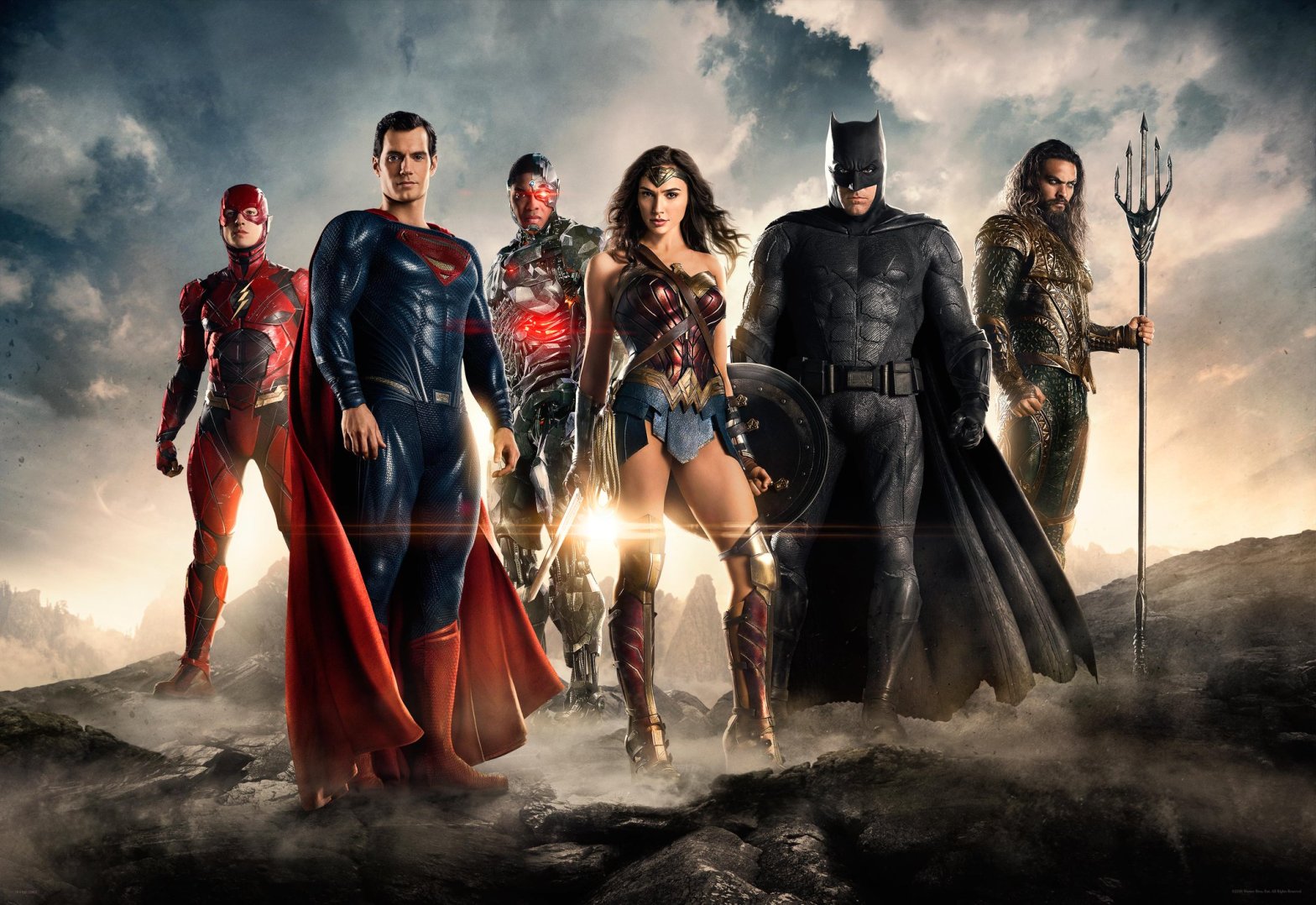
Enter Twitter, where only good, healthy topics are discussed in a civil forum. #ReleaseTheSnyderCut has seemingly caught cultural fire and is trending on social media. The hashtag is in reference to director of the 2017 critical and financial catastrophe known as “Justice League”, Zack Snyder, who supposedly has a cut of the film that has not been released to the public. As of writing this post, the hashtag has roughly 750K tweets, including one from every one of the main cast and Snyder himself, which is significant enough for me to take notice and release an audible groan followed by a rant to tell those kids to get off my lawn.
For reference, the reason that there is a 2nd version of the film is Zack Snyder is not the only credited director on “Justice League”. Snyder suffered an incredibly unfortunate tragedy when his daughter took her own life at age 20 during post-production. Understandably, he decided to walk away from the film before it was finished to be with his family. Joss Whedon, director of the first two “Avengers” films for Marvel, was hired to oversee the rest of post-production and film new scenes that he both wrote and directed. Obviously, this was a horrible situation for the Snyder family, and when I go on my rant here, I do not intent any offence with regards to the real-life trajedy.
But I mean, really guys? Do you really want to do this? Is this really a hill you want to die on? That Zack Snyder, of all people, has a cut of the film that will somehow redeem “Justice League”? I’ll give you that the bar is impossibly low right now, and the odds of whatever cut he’s sitting on being better than the dumpster fire we’ve seen are probably fairly high. But stop it. No one is legitimately buying that this unseen version is so good that it actually redeems the film. We have all seen “Batman v Superman: Dawn of Justice”. I am quite confident the Snyder cut does not have anything remotely worth our time in it. And, if the director’s cut of that film is anything to go by, we might be in store for a 3 1/2 hour journey. Unless your name is Martin Scorsese, you have ZERO business making a film that long.
“Justice League” came out almost 2 years ago at this point, and we have had more than enough quality comic book films in the interim to fill the void. The reality is, we have all moved on. If you think it is impressive that 750,000 people were tweeting about it, just remember that our country alone has about 400,000,000 people. Not that it matters, but that is only 0.19% of the US, assuming that all of those Tweets came from the US, which isn’t the case. If we generously estimate that everyone of those people will buy a ticket at $20 a piece to see this version, that’s still only $15 million. In the world of big-budget blockbusters, that’s petty cash. To put it in perspective, the film lost the studios an estimated $60 million upon initial release WORLDWIDE. So, congratulations! The internet made me do basic math and still no one is interested in reliving this mess of a movie.
And the executives at DC Comics and Warner Bros. say there is absolutely no chance of them releasing the Snyder cut, which is an unexpectedly intelligent stance for them to take. The DCEU sucks and they know it. Other than “Wonder Woman” and “SHAZAM!”, the remaining films from the series contain such a foul, pungent odor that is nothing more than an insult to life everywhere (Don’t lie about “Aquaman”. It was ok at best). But things have started to look up for DC now that “Joker” will be the first Rated-R movie to ever gross $1 Billion, and the promise of “Birds of Prey” and “Wonder Woman 1984” offers plenty of encouragement. What possible force on Earth could compel them to want to relive one of their most embarrassing failures in recent history? Because Ben Affleck decided to take the time to tweet even though he strong-armed his way out of his contract to play Batman after THIS movie embarrassed him that much? Let me know how that one turns out.
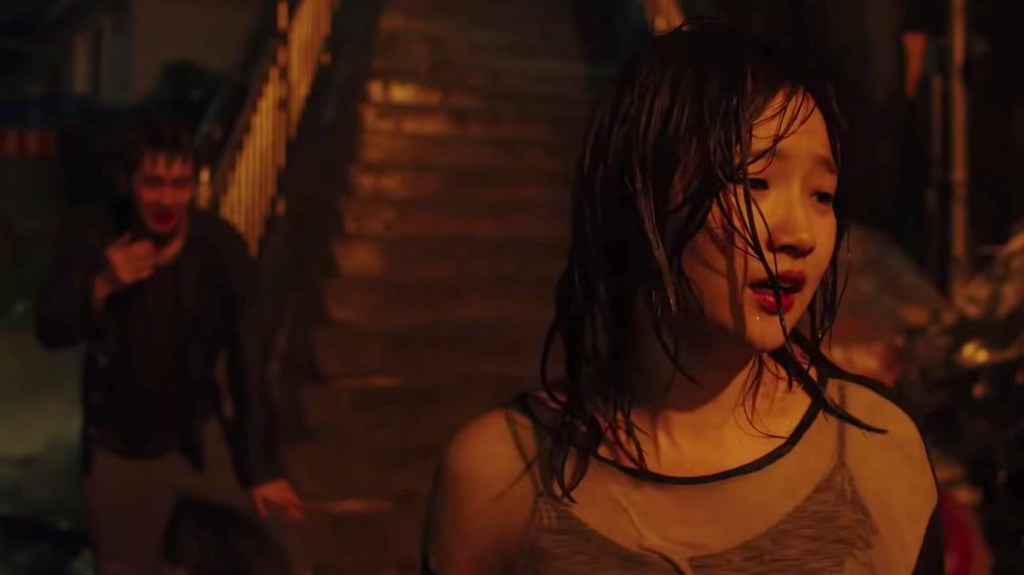
It is a rare occurrence that an Eastern film would get any mainstream attention upon its initial release in the West. Most often it is not an issue of quality, but culturally, there can often be a bigger disconnect between audiences with content than opposed to that of other Western films. So, when a South Korean movie like “Parasite” comes around and begins to make a lot of noise at film festivals and early screenings, my curiosity cannot help but be piqued. There must be something about this particular film that helps it transcend cultural and language barriers and that element must be special.
As it turns out, there is a multitude of factors that help make “Parasite” the phenomenon it is being propped up as. For starters, the story about the lower-income Kim family systematically infiltrating and scamming the upper-class Park family until their actions come to a head is an incredibly enthralling premise that never lets up. The sequences in the first act of the film where they, one-by-one, manipulate the members of the elite family to gain their trust and employment draw comparisons to a much more subtle and nuanced version of an “Oceans 11” heist. There are moments of incredibly stressful suspense that are not brought on by anything more than the proximity to consequences and this is a continued mechanism that grows as the plot develops. This all culminates in a story that is engaging in a way that does not stagnate and continues to keep the audience on its guard for an ever-changing status-quo.
What it comes down to is that the script for “Parasite”
is the most tactfully written of any for a film I have seen the entire year. The
story is crafted with such a precision that only a few filmmakers with such
explicit goals and visions can achieve. However, there is an obstacle that this
film faces that Western films do not: translations. When part of the experience
of watching a film is a reliance on the audience to read the dialogue, as
opposed to effortlessly listen to what is being said, there is an inherent
challenge in effectively communicating emotions, exposition, wit, and especially
subtlety. This is yet another area where “Parasite” thrives in the face of an
uphill battle. I went to see this film with two friends who do not usually
watch foreign films and even they say they were constantly engaged with the
dialogue, much to their surprise. There are moments of undeniable humor and
tension that might have otherwise fallen flat due to the complications, but
stand out as genuine triumphs because of how expertly crafted they were.
The entire cast does a noteworthy job in their roles. The
Kim family each have their own unique traits of cunning and desperation. So-dam
Park’s Ki-Jeong is my personal favorite. She is the Kim family daughter and
many of her scenes are the most intelligently manipulative of all while still
being some of the funniest bits of dialogue in the film. Kang-ho Song plays the
father of the Kim family who is submerged so deeply into his family’s infiltration
of the Parks, his growing awareness of how little they care about the workers
is the audience’s window into the social commentary. And the Park family presents
a great foil to them. They are all, except for their notably gifted young son,
incredibly naïve, yet possess so much power. Although they seem to not even be
aware of the situation they find themselves in, the present a legitimate
presence simply because of their wealth and the influence that provides.
Many films explore the idea of inequality in society, so the subject is not especially new. However, is any idea completely original? What makes “Parasite” stand out is how it goes about constructing an entertaining situation that that is realistic enough to be believable but challenging enough that it stretches the boundaries of the imagination in a thought-provoking manner. The story is fun and that may be the most important reason it effectively communicates its message. Director Bong Joon-Ho deserves all the credit he is receiving for constructing a film like this. He was able to balance themes, a cast of roughly 9 main characters, and a compelling narrative to create an incredibly intense experience with a story that is poignant to all people.
The public has an undeniable curiosity towards what this film is, so much so that it seems to be growing by the day. Most films have their hype slowly begin to fade after a noteworthy genesis, but this movie is showing itself to have legs. “Parasite” has already earned the highest box-office total of any foreign film this year, and it is a status it is in zero jeopardy of losing. We should appreciate the fact that it is adding to an eclectic collection of cinema in 2019, and “Parasite” is a worthy candidate to be in the mix for best film of the year.
I give “Parasite” a 9.3 out of 10
Starring: Kang-Ho Song, Yeo-Jeong Jo, So-Dam Park, Woo-Sik Choi, Sun-Kyun Lee, Ji-So Jung Directed by: Bong Joon-Ho Rated: R Runtime: 2 Hours and 12 Minutes
According to CBS News, Magic City Films have secured the rights and permissions from the family of the late actor James Dean to use his likeness to star in an upcoming Vietnam War drama called “Finding Jack”. Using the mystical powers of computers, Dean will apparently be playing the role of a man named “Rogan” and will serve as the 2nd lead who undergoes “extreme character arcs”. Dean’s family says they will consider this James’s 4th official film, after “East of Eden”, “Rebel Without a Cause”, and “Giant”.
If you read that and thought “Wow… that seems kind of screwed up!” then you and I are on the same wavelength. We have come to the point where we have the ability to recreate deceased human beings and forcibly use their likeness to create statements and expressions that they have never made. What gives anybody the right to impose themselves and their opinions like that on a person who is no longer with us, and then claim it as if it were their own works? Ethically, this is outrageous. What if, after you had passed, your great-niece and great-nephew sold off your likeness to a cigarette company for a series of advertisements? I bet you would at least have SOMETHING to say about that, but unfortunately, other people decided that you will do that.
I am the last person in the world to get spiritual, but I thought we were supposed to be at rest when we died. Death has always been a definitive finish line to life. When your time is up, your book closes. Maybe there is a epilogue about the legacy you leave behind, but everything that you do in the physical is over at that point. The permanence and silence is really what makes death so impactful to the people around you. It feels borderline insane to recreate a dead person and pretend they are still alive, but also incredibly disrespectful to the person who is supposedly at rest.
James Dean died at age 24 in 1955, a full decade before the actual start of the Vietnam War. I am not saying he would have a political stance towards the war, or that he would even have any issue portraying a character who is in the war, but he left this world not knowing of anything that he is representing. The film could end up being beautiful and a performance that Dean might have been proud of if he were alive, but unfortunately, there is no possible way to ever know that. Essentially, this CGI version of James Dean is a puppet being operate by people he has never met to talk about issues and events he had no knowledge of, and then the work will be attributed to James as if he consented and made those expressions himself, which he has not.
There are two comparable examples of CGI recreations of actors that I can recall that I should address. In “Rogue One: A Star Wars Story”, Carrie Fisher’s Princess Leia and Peter Cushing’s Grand Moff Tarkin were recreated using motion-capture CGI techniques. At the time, both of the recreated actors had passed (although Carrie Fisher was alive during production) so it is reasonable to associate that instance with this one. But there is a key difference: Both of those actors already played characters in ‘Star Wars’ when they were alive and it was those characters that were recreated, not the actors themselves. And, both of those performances were credited to the actors doing the motion-capture, not the people that were being recreated. This means no one even attempted to pretend that these roles in the movie are attributed to the original actors, only inspired by them.
And aside from the profound moral issues of dragging the corpse of a dead person out of the ground to perform for our amusement, you’re trying to tell me that there were NO actors alive who could do this role? The article says that they did an immense search for months for someone before agreeing to give the role to the late-Dean. My guess is they must have not looked very hard if the ONLY acceptable performer you found is the recreation of a dead man from 64 years ago in a computer. That sounds incredibly unrealistic. If I had to guess, this is a publicity stunt to get us talking about a film that otherwise could have flown under the radar (Good job. I took the bait), or maybe you always wanted James Dean in your movie and this half-assed story is the only way you could justify it to the public. Either way, I do not feel anybody is being honest.
Everything about this story makes me feel uneasy. We have the ability to do so many things no one ever thought possible at one point, but we must ask ourselves if it is really worth it. If we cross this line, we may never go back again. I am not one to romanticize “the way things are” but this particular path is not one we should go down. Change is inevitable and our morals will shift with the times, I just hope this is not where we are a headed.
What do you think about this situation? I know I just laid out a total rebuke of the whole thing, but maybe someone disagrees with me. I am very curious how someone might defend this, but I would love to hear from people who have any thoughts about this because it is important to engage about topics like this.
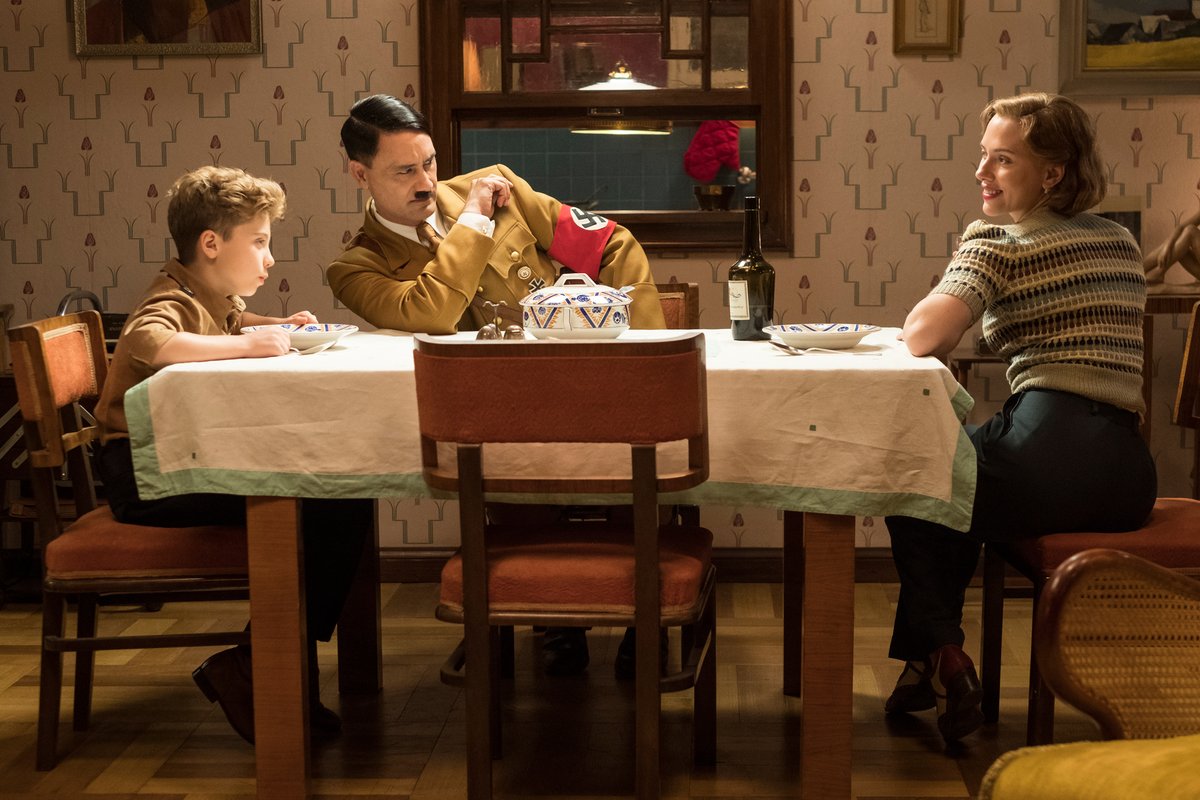
“Jojo Rabbit” is the newest production from “Thor: Ragnarok” director, Taika Waititi. It is a movie which he has touted as a work of modern satire with a story that follows a young German boy during the waning days of WWII named, Jojo, who is an absolute Nazi fanatic. Jojo’s life seemingly revolves around the Third Reich and he even has an imaginary friend-version of Adolf Hitler, played by Waititi, with whom he frequently converses and seeks advice from. After Jojo nearly blows himself up with a grenade at Nazi Youth camp, he goes home to find his mother is harboring a Jewish girl named Elsa. The film explores the dynamic between Jojo and Elsa, and how his prejudices correspond to reality.
All of the elements for a deeply compelling film exist, but “Jojo Rabbit” is, unfortunately, a conceptually very intriguing premise that ends up being lesser than the sum of its parts. To use a baseball metaphor, this film is essentially a warning-track fly ball. One definitely needs to be talented and know how to swing a bat to hit a ball that far, but ultimately it is still an out. Merriam-Webster defines satire as “wit, irony, or sarcasm used to expose and discredit vice or folly”. Bodies of political satire, such as this, have a goal to be thought-provoking and challenge the way the masses perceive political institutions and social ideals. They succeed when audiences have a grand epiphany and see dynamics in a light they never considered before. But when the extent of insight the film presents is that Nazis are bad and they used fear and lies to get people on their side, one can’t help but feel underwhelmed.
The major issue that arises is that Nazis are already a group on the fringes of society that are always opposed for their twisted ideologies. It is neither a bold nor a unique take to criticize Nazis, and the film never strays away from that one focus. World War II ended in 1945… a cool 74 years ago. German Nazis are not really a problem in today’s world anyway, and the exposure of their faults seems unnecessary as there is nothing to affect. However, nothing exists in a vacuum and if anyone is familiar with Taika Waititi, they are probably aware of what his political views are, as he displays them for anyone to see. I can confidently make the claim that he is trying to present parallels between Nazi Germany and today’s political climate, but he comes up short here also. The film does not offer a legitimate challenge to the tactics or philosophies that inspire movements, such as German Nazism. Instead, it only chooses to belittle those movements, as if no serious person would ever consider them in their right minds, which is almost begging for it to happen again.
To its credit, the film does not bombard the audience with a blitzkrieg of MAGA jargon that would otherwise remove all subtlety and thought entirely from the viewing experience. But, because Waititi’s script is seemingly married to the idea of parodying German Nazis as people, he neglects to have many substantial discussions on their political ideologies, a subject which can transcend the events of the film. The ideas of fearmongering, scapegoating, and nationalism are barely examined beyond surface-level acknowledgments of their existence. Instead of learning why people might be compelled to be swayed by those tactics, they are presented as nothing more than exaggerations and caricatures in a 10-year old’s imagination. In fact, most of the adult characters in the film openly mock Jojo for believing Jews have horns and mind-control powers, despite it being the very propaganda they are pushing to him, as if their messages, which put them in power, are nothing more than fairytales for children. The film just does not offer enough philosophically to truly get anybody thinking any differently than they did when they walked into the theater.
Although I may be critical of the execution, there are many enjoyable qualities to the film as well. The acting is superb, especially from Roman Griffin Davis and Thomasin McKenzie, as Jojo and Elsa respectively. They are both tasked with providing the audience with innocent surrogates in which to relate to and can sympathize with. They are both victims of their circumstances: Elsa, a Jewish girl hiding for her life simply because of who she is; Jojo, an impressionable child who adopts a hateful ideology because everyone tells him it is the right way to be. You watch them grow from fearful adversaries to eventual friends and it is truly a pleasure to watch. Scarlett Johansson and Sam Rockwell are also tremendous as a mother and a mentor to Jojo, and Waititi’s role as figment-Hitler is certainly interesting. While the other characters provide legitimate support to the young boy, he portrays the god-like image of what Jojo believes Hitler is like. He advises Jojo in a way that a child would believe an adult thinks. He also has a few mildly comedic moments, but it is mostly just the goofy antics of a child’s imagination.
“Jojo Rabbit” is a charming film that is by no means of poor quality. It has moments of sentiment, melancholy, and humor, but it, unfortunately, just misses its mark with its primary purpose. It is a film that seemingly would work better as a coming-of-age story rather than a political satire. While it lacks the profound messaging that I feel it needs to match the importance of the subject-matter, there is still a fine story about doing what you can to be better than you were yesterday buried underneath the façade of “funny Hitler” and German Rebel Wilson giving children guns. It seems though that the movie wants so desperately to be poignant with commentary, it didn’t realize other routes could have been even more effective.
I give “Jojo Rabbit” a 7.5 out of 10
Starring: Roman Griffin Davis, Thomasin McKenzie, Scarlett Johansson, Taika Waititi, Sam Rockwell, Rebel Wilson Directed by: Taika Waititi Rated: PG-13 Runtime: 1 Hour and 48 Minutes












 Shut Up Zach!